Author: John
-
SIP and NAT: Why is it a problem?
•
Why is it a problem using SIP Clients behind NAT? What is NAT? To understand why SIP Clients behind NAT are a problem, you need to first have some understanding of what NAT is and what it does. NAT stands for Network Address Translation. Unless you are using One-to-one NAT, then a NAT device may also perform Port Address Translation (PAT). For a detailed explanation of NAT click here. If you want, you can also read…
-
SIP Outbound Proxy Server Explained
•
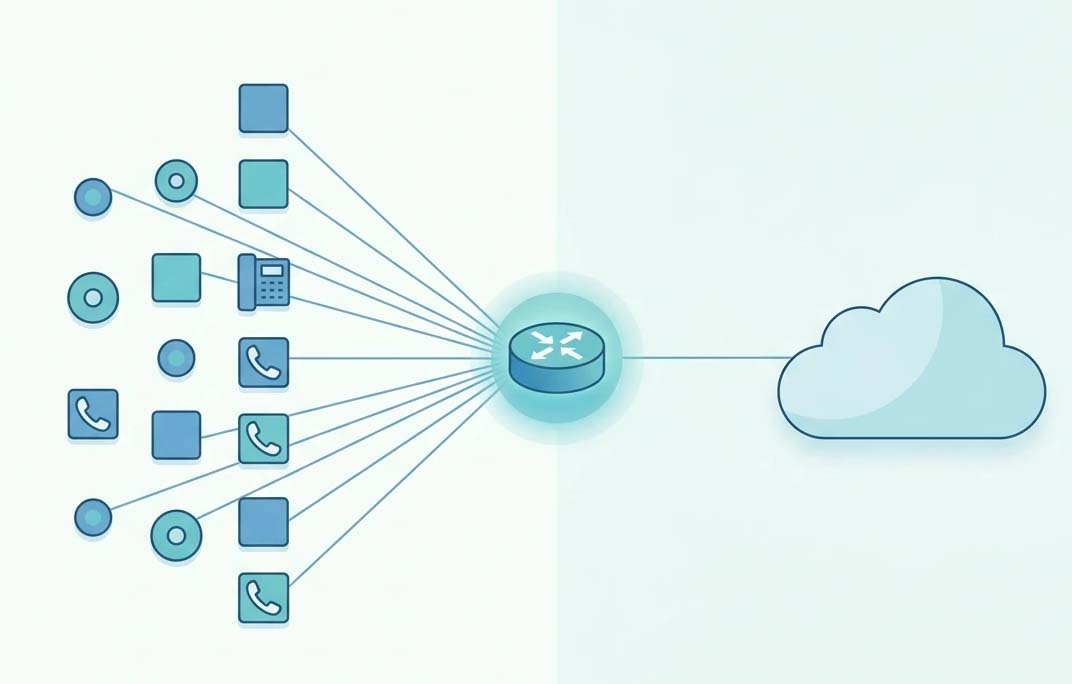
Why do IP Phones require a setting for ‘Outbound Proxy Server’? Outbound Proxy Server When you look at the configuration options on most IP phones, you will see a field called “Outbound Proxy” or “Outbound Proxy Server”. In this field you can enter an IP address, a host.domain name or just a domain name (as long as it can be resolved to an IP address in DNS). It is an optional field, but if you enter…
Image generated with Craiyon
-
IP Phone Configuration: SIP Proxy Server
•
What is the ‘SIP Proxy Server’ setting on an IP phone? It might be called something different on your IP phone In their wisdom, each manufacturer has made different decisions about the naming of data parameters on their IP phones. So if you look at a Snom phone it uses different names to those on a Grandstream etc. The differences sometimes go beyond simply giving a different name to the same parameter and there may even…
-
SIP Registration Explained
•
How does SIP Registration work and why is it needed? Registration – what it is and why it is necessary IP Phones (and SIP clients in general) need to register with a central server mainly because this allows the phone’s location to be known when it is required to receive an incoming call. The “location” is identified by an IP address and port number. In some cases the IP address might be permanent and fixed, in…
-
SIP Servers Explained
•
What are SIP Servers and why are there so many? SIP and SIP Servers – a brief explanation SIP is a general purpose Session Initiation Protocol that can be used as the basis for a range of services that extend beyond VoIP to video, Presence and beyond. It is a powerful and highly versatile protocol that can be used for signalling and to establish and terminate communication sessions between end-points. Even within the voice environment, SIP…
-
Taking the plunge with SIP Trunks – Part 3
•
Outbound calls; Matching a DDI/DID; Diagnosing problems; Internet bandwidth. Configuration for Outbound calling Part 2 looked only at the configuration for receiving inbound calls, but the SIP Trunk configuration form in Trixbox/FreePBX has to also include the settings for making outbound calls. It may not even work at all if you only use the inbound call settings shown in part 2. Caveat – this only refers to chan_sip and not pjsip. You will need a peer…
-
Taking the plunge with SIP Trunks – Part 2
•
Recap In part 1, I explained how a SIP Trunk is really just a virtual connection between your IP-PBX and the VoIP service provider. Standard SIP signalling is used on the trunk, but more than one simultaneous call is allowed and you may have more than one DID number. Basic requirements to enable your SIP trunk A SIP Trunk may be used for both inbound and outbound call traffic. To make outbound calls, your Asterisk, FreePBX…
-
Taking the plunge with SIP Trunks – Part 1
•
Many VoIP service providers offer SIP Trunks as a standard product, but just what is a SIP trunk and what can you use it for and how do you make it work with Asterisk or FreePBX? I will attempt to answer these questions in this 3 part blog, starting with the basics. What is a SIP Trunk? A SIP trunk uses standard SIP signalling, but the endpoints of the trunk are fixed – typically one end…
-
RTP pass-through mode in Asterisk
•
What is RTP pass-through mode in Asterisk? The speech for VoIP calls uses RTP (Real Time Protocol) to get from one end to the other and it is compressed using one of the many speech compression codecs available. Commonly used codecs include G.711 and G.729. When you call someone through an Asterisk PBX, there will be two “legs” to that call. The first leg is from your phone to Asterisk and the second is from Asterisk to…
-
How can an Asterisk IP-PBX benefit my business?
•
In a Nutshell: The benefits of upgrading to an Asterisk based IP-PBX
