Tag: SIP
-
How secure is your Asterisk PBX? – part 2
•
Protecting your Asterisk server In part 1, we examined the techniques that are used to probe for vulnerabilities in a SIP server and reviewed the types of exploitation a would-be hacker hopes to use. In this second part, I look at the ways you can protect your Asterisk or other SIP server and guard against weaknesses that could potentially cost your organisation a lot of money. This article was written before the pjsip channel driver was available,…
-
How secure is your Asterisk PBX? – part 1
•
A growing problem Like a slice of Victoria sponge cake on a summers day attracts wasps, so new technologies seem to attract the attention of cyber-criminals. The more widely used the technology, the greater the interest. It was inevitable, and widely predicted, that VoIP would become a favorite target for hackers as its popularity and uptake increased – it has the accessibility of an email server combined with the potential for fraud of an online bank account. Irresistible! And so…
-
Installing Mediaproxy 2 on CentOS 5 64bit
•
Mediaproxy 2 is a Python application from AG-Projects which is available as a free download as well as being available as a commercial product from AG-Projects. It is used in combination with the Mediaproxy module of OpenSIPS. Unlike Mediaproxy 1, the new version has a lot of dependencies and it can be quite tricky to install. The INSTALL instructions that come with the package are very helpful, but unfortunately they are aimed primarily at installers who…
-
IP Phone Configuration: User Account Settings
•
Manufacturers different naming conventions While SIP is an industry standard protocol, the names assigned to the configuration fields on an IP phone are far from standardised. The tables below show the text labels that you can expect to see on the web interface configuration forms next to the boxes where you must enter your settings. We show examples of the labels used for equivalent fields by four manufacturers: Snom, Aastra, Grandstream and Linksys. User accounts There…
-
Installing OpenSIPS v1.6.1 on CentOS 5 64bit
•
Smartvox Limited offered consultancy for installation and configuration of OpenSIPS, Asterisk and PSTN gateways. If you want to do it all yourself, here is a set of instructions that should help. Installing OpenSIPS v1.6.1 on CentOS 5 64 bit is very straightforward. All the dependencies can be installed using YUM. The packages required will depend on the modules that you intend to use from OpenSIPS. This page describes what must be installed to use OpenSIPS with…
-
Asterisk behind NAT
•
Scenarios in which NAT may adversely affect Asterisk SIP connections The Asterisk Server is behind NAT The Asterisk server could be on the LAN (or in a DMZ) with a NAT firewall between it and the Internet. When it communicates with external peers or devices, the network connections have to pass through the local NAT device. The remote device that is connecting to Asterisk is behind NAT Suppose that your Asterisk server is connected directly to…
-
Using SIP Devices behind NAT
•
SIP Devices behind NAT: What solutions are available? When an IP phone is installed behind NAT, problems can be created by the NAT device itself, by the phone’s inability to correctly understand its own networking environment or from a combination of the two. Because it is such a common problem, most IP Phones have built-in facilities designed to help them analyse their own networking environment and to help overcome the problems of NAT traversal. Probably the…
-
SIP and NAT: Why is it a problem?
•
Why is it a problem using SIP Clients behind NAT? What is NAT? To understand why SIP Clients behind NAT are a problem, you need to first have some understanding of what NAT is and what it does. NAT stands for Network Address Translation. Unless you are using One-to-one NAT, then a NAT device may also perform Port Address Translation (PAT). For a detailed explanation of NAT click here. If you want, you can also read…
-
SIP Outbound Proxy Server Explained
•
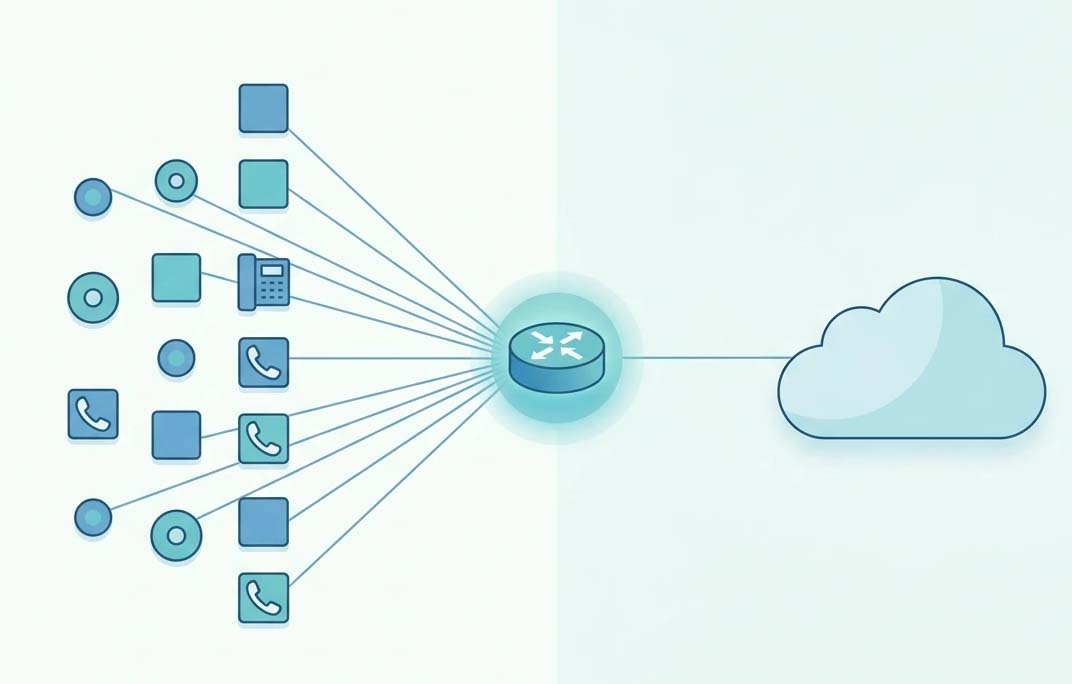
Why do IP Phones require a setting for ‘Outbound Proxy Server’? Outbound Proxy Server When you look at the configuration options on most IP phones, you will see a field called “Outbound Proxy” or “Outbound Proxy Server”. In this field you can enter an IP address, a host.domain name or just a domain name (as long as it can be resolved to an IP address in DNS). It is an optional field, but if you enter…
Image generated with Craiyon
-
IP Phone Configuration: SIP Proxy Server
•
What is the ‘SIP Proxy Server’ setting on an IP phone? It might be called something different on your IP phone In their wisdom, each manufacturer has made different decisions about the naming of data parameters on their IP phones. So if you look at a Snom phone it uses different names to those on a Grandstream etc. The differences sometimes go beyond simply giving a different name to the same parameter and there may even…
